
Kankakee County Court Records After a Jail Arrest
An arrest in Kankakee County puts a person in the jail and creates a booking record, but it does not by itself create a court case. The court record begins when the Kankakee County State's Attorney reviews the arrest and files a charging document. That filing opens a case in the 21st Judicial Circuit, and the Circuit Clerk keeps it from that point forward. The State's Attorney, currently Jim Rowe, prosecutes all felony and misdemeanor cases in the county.
The arrest side and the court side answer different questions. The booking record on the jail roster shows custody, classification, and the charges recorded at intake. For the booking detail and custody status, the jail inmate records page covers the roster, and the jail mugshots page covers booking photos. The court record, by contrast, shows the charges the prosecutor filed, the hearings, and the final disposition.
How to Find Kankakee County Court Records After an Arrest
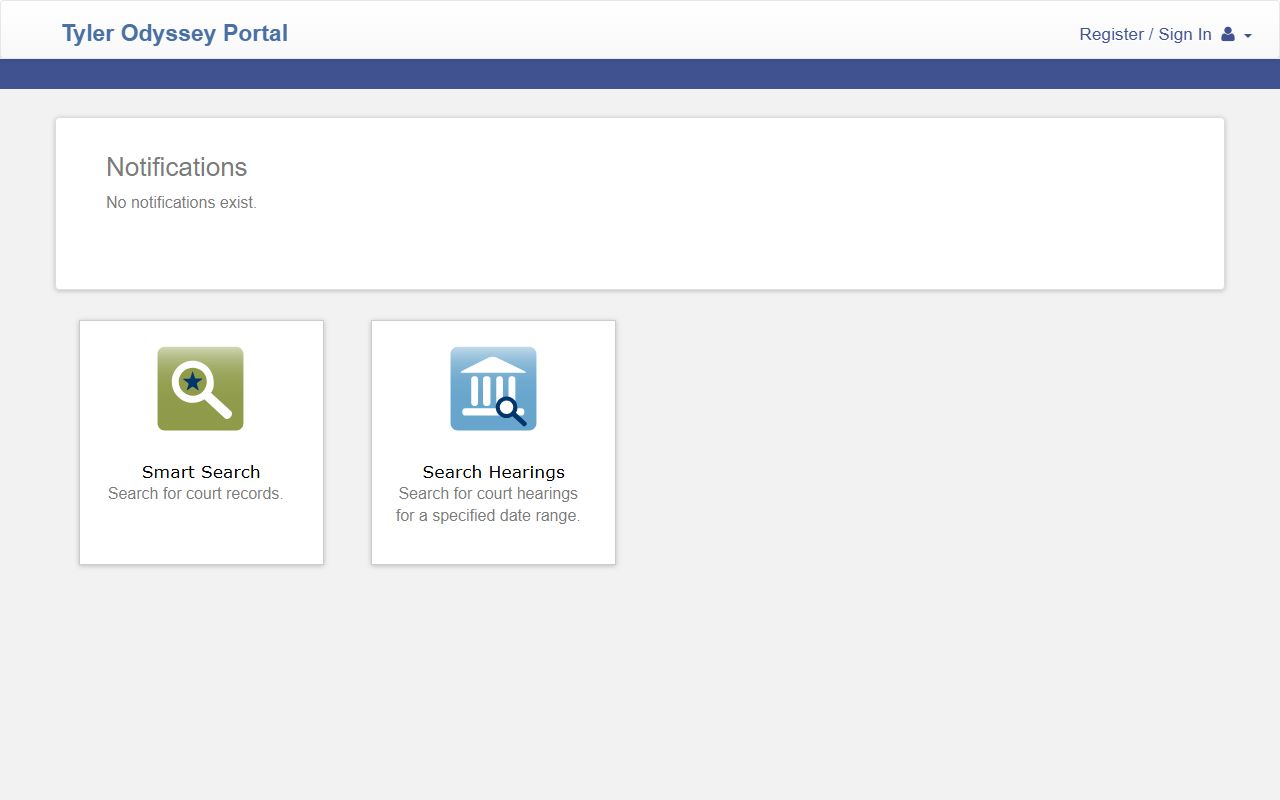
Filed charges and case status live in the county court portal, not on the jail roster. Kankakee County uses the Tyler Odyssey Portal, reached through the Circuit Clerk, with a Smart Search tool and a Search Hearings tool. The portal needs a modern browser with JavaScript and cookies. The image shows the portal landing page.
The Tyler Odyssey court portal offers Smart Search for records and Search Hearings for upcoming dates.
From the portal, the search runs in a few steps.
- Open the Circuit Clerk site and follow the Online Portal link to the Tyler Odyssey Portal.
- In Smart Search, enter a case or docket number, or a name in last, first format.
- Open the case to read the charge list and the documents filed.
- Check each charge's code, level, and current status, and use Search Hearings for upcoming dates.
The county court portal can also search by booking number, which is a useful bridge from the jail roster to the court case. A complete statewide criminal-history report is a different product, handled by the Illinois State Police Bureau of Identification rather than the Sheriff or the clerk.
Court Record Search Fields
The Smart Search tool accepts a range of identifiers, which helps when a name is common or a case number is unknown. The fields below come from the inspected portal.
| Field Label | Type | Notes |
|---|---|---|
| Record Number or Name | Text | Main Smart Search field, last, first middle suffix format |
| Last Name / First Name | Text | Party search by person name |
| Date of Birth | Date | Narrows a common name |
| Booking Number | Text | Bridges a jail roster record to the court case |
| Case Type / Case Status | Filter | Criminal or civil, open or closed |
| File Date Range | Date | Limits results to a filing window |
How Charges Get Filed After an Arrest: Complaint, Information, and Indictment
The path runs from the arrest to a filed charge. After booking, a person arrested for a detention-eligible offense must be brought before a judge without unnecessary delay, within 48 hours, with a charge filed. The charge record begins when the prosecutor files a charging document. Felony cases can move forward through a preliminary hearing or a grand jury. The three main document types are below.
| Complaint | Information | Indictment | |
|---|---|---|---|
| Filed By | Officer or prosecutor | Prosecutor | Grand jury |
| Common For | Misdemeanors | Many felonies | Serious felonies |
| Starts | The case | The case | The case |
Charge Status and What It Means
Charges change as a case moves. A prosecutor may amend, reduce, add, or drop a charge, and a judge may dismiss one. The charges recorded at jail booking can differ from the charges the prosecutor finally files, which is why a roster line that reads only "Warrant" may not explain the real court charge. The common status terms are defined below.
| Status | What It Means |
|---|---|
| Pending | The charge is filed and has not reached a final outcome |
| Amended / Reduced | The wording, degree, or count was changed, sometimes to a lesser offense |
| Dismissed | The charge ended without a conviction |
| Nolle Prosequi | The prosecutor chose not to proceed on the charge |
Release and Detention After an Arrest
Illinois changed how release works. Cash bail ended statewide in September 2023 under the Pretrial Fairness Act, so a judge now decides release conditions or detention rather than a dollar amount. After booking, the case begins with a first appearance, and for eligible offenses the prosecutor may file a petition to deny pretrial release. The roster still shows fields labeled Total Bond and Total Bail, but a status such as Detained means the person is held by court order, not that a cash payment will free them.
| Term | How It Works in Illinois |
|---|---|
| Cash Bail | No longer used as a release condition as of September 2023 |
| Release With Conditions | The person is released on a promise plus court-set conditions |
| Pretrial Detention | The court orders the person held after a detention petition |
| Hold / Detainer | Another agency asks that the person stay in custody |
Warrants That Lead to an Arrest
An outstanding warrant is a common route into the jail. A person arrested on a Kankakee County warrant may appear on the Tyler roster after booking, with a charge row that reads "Warrant-Kankakee County" and a status like Detained. The county does not publish an online warrant search. The Sheriff's Investigations Division handles wanted-person questions through a warrant clerk at 815-802-7150 during business hours, and KanComm Dispatch at 815-933-3324 after hours. A warrant line on the roster does not explain the underlying case, so the court portal or the Circuit Clerk should be checked for the filed charge and hearing status.
Charges vs. Convictions
Being arrested and charged is not the same as being convicted. A charge is an accusation that a case must still prove. A conviction is a verdict or plea. Both can appear in a public court record, so reading a case carefully matters.
| Charge | Conviction | |
|---|---|---|
| Stage | Accusation | Verdict or plea |
| Burden of Proof | Probable cause | Beyond a reasonable doubt |
| Public Record | Yes | Yes |
Sealed vs. Expunged Court Records
Illinois law lets people clear eligible records after a dismissal or an eligible outcome. Sealing and expungement are governed by 20 ILCS 2630/5.2, and the Kankakee Circuit Clerk handles these filings on the second floor of the courthouse, in Room 209. The State's Attorney also runs a local expungement help program. The two remedies differ in how far they go.
| Sealed | Expunged | |
|---|---|---|
| Visibility | Hidden from most public view | Destroyed or treated as if it never existed |
| Law Enforcement | Limited access remains | Very limited access |
| Eligibility | Set by 20 ILCS 2630/5.2 | Set by 20 ILCS 2630/5.2 |
For removing a booking photo tied to a cleared case, the jail roster mugshots page explains the records-clearing route.
Court Contacts and Older Court Records
Not every court record is searchable online, and older files sometimes need a call or a visit. The Kankakee County Circuit Clerk keeps and preserves the court files, processes filings, and collects court fees and fines. The courthouse sits at 450 E Court Street in Kankakee, where the clerk's office is open on weekdays during courthouse hours.
The Search Hearings tool in the court portal lists upcoming court dates by name or case number, which helps when a person has a hearing but the case result is hard to identify. For a record the portal cannot reach, the clerk can be contacted by phone or in person. Digital recordings of proceedings are kept, and transcripts are arranged through the court reporter supervisor named in the Illinois Courts directory. Court files sit outside the county FOIA process, so they run through the clerk rather than a sheriff or county records request.
Kankakee County Circuit Clerk
450 E Court Street
Kankakee, IL 60901
815-936-5700
Mon to Fri, 8:30 a.m. to 4:30 p.m.
Note: cell phones, tablets, and laptops are not allowed in the courthouse except by special permission for attorneys and court staff, so plan a visit accordingly.
Background Check Considerations
A casual court-record lookup is not the same as a regulated background check. Formal screening for jobs, housing, or credit must follow the federal Fair Credit Reporting Act and use a licensed consumer reporting agency. The court portal and a public records search are research tools, not screening reports.
Important: This site is not an FCRA-regulated consumer reporting agency, and its content may not be used for hiring, tenant, credit, or insurance decisions.
Restricted Court Records After an Arrest in Kankakee County
Not every record is open. Juvenile cases carry confidentiality protections, sealed and expunged charges drop from public view, and some dismissed charges may be withheld. Illinois law can also limit release of arrest information when disclosure would interfere with an active investigation, endanger safety, or compromise jail security. Court files themselves sit outside the county FOIA process, so they are obtained through the Circuit Clerk and the court portal rather than a sheriff or county records request.